


A few weeks ago, I was listening to my own podcast — which is a weird thing to admit, but here we are — and Robin Johnson, our guest on Episode 72 of Brave New Bookshelf, said something that has stuck with me. She compared AI to a hammer, and the person using it to a carpenter. The hammer doesn’t build the house. The carpenter does. The hammer is just a tool — a useful one, sure, but one that requires skill, intention, and judgment from the person wielding it.
I love that analogy because it cuts straight through one of the biggest misconceptions about AI in fiction writing: the idea that the tool is going to do the work for you. It’s not. It can’t. And honestly, you wouldn’t want it to.
But I want to extend Robin’s framing a little, because the way I think about AI in my own writing process is slightly different. I don’t think of it as a hammer, exactly. I think of it as a junior writer. Capable. Eager. Surprisingly good at certain tasks. But also someone who needs a lot of direction to do the job right — and who will absolutely hand you something average if you don’t push them past their defaults.
AI Was Designed to Be Average
I didn’t realize this until I saw how the models work, but AI was built to be average. Or maybe just slightly above average. That’s the design. When you ask an AI to write a scene, it’s predicting the most likely response based on everything it’s been trained on. And the most likely response, by definition, is the most common one. The expected one. The average one.
That’s true for everything — text, images, ideas, plot beats, character reactions, dialogue. The AI’s first instinct is to give you the most predictable version of what you asked for.
Sometimes you get lucky. Every now and then the AI surprises you with something genuinely brilliant, something out there, something you couldn’t have come up with on your own. But that’s not how it was designed. It was designed to be average. So if you accept what it hands you on the first pass, you’re getting average prose, average stakes, average characters, average choices. And nobody is buying average. Average is what sinks like a stone in the Amazon rankings.
This is why direction matters so much. The AI doesn’t know what kind of book you’re writing, who your readers are, what your voice sounds like, or where the emotional beats need to land — unless you tell it. And even when you tell it, you often have to tell it again. And then ask it to push further.
The Default Trap: A Real Example
Let me give you a concrete example from my own work. I draft a lot of fiction with Claude these days, and Claude has a particular default style I’ve come to call “reporting.” He writes like a newscaster — accurately describing the events of a scene, in the order they happen, with minimal deviation. The character moves. The character speaks. The character thinks a thought. Next event. Next event. Next event. (I’ve spoken of this tendency before, so bear with me here.)
It’s competent. It’s technically correct. And it’s robotic.
What’s missing? The little asides. The truncated sentences. The breaking of the fourth wall. The pause where the character almost says something and then changes their mind. The internal monologue that lets the reader live inside the character’s head for a beat longer than they expected. All the little flourishes that turn flat prose into prose that feels like something.
I have to ask Claude for those things. I have to remind him. I have to give examples. And even then, he doesn’t always give them to me — junior writers still have a lot to learn. So when the draft comes back without those flourishes, I add them myself. Every time. That’s not a flaw in the workflow. That is the workflow.
Treat It Like a Junior Writer, Not a Peer
So, let’s reframe this: the AI is your junior writer, not your peer. And junior writers need direction.
A junior writer needs you to tell them what kind of scene this is. What the character wants. What the tone should be. What stakes are on the table. What to push towards and what to pull back from. They need you to look at their first draft and say, “This is a good start, but I need you to take it further.” They need you to be the one making the editorial calls, because they don’t have the experience yet to make them on their own.
That doesn’t mean they’re useless. Far from it. A good junior writer can save you enormous amounts of time, surface ideas you wouldn’t have considered, and turn a blank page into something workable. But they’re not in charge. You are. And the moment you forget that — the moment you start treating the AI like an equal collaborator whose first output deserves your trust — is the moment your story starts drifting toward average.
Be Starbuck
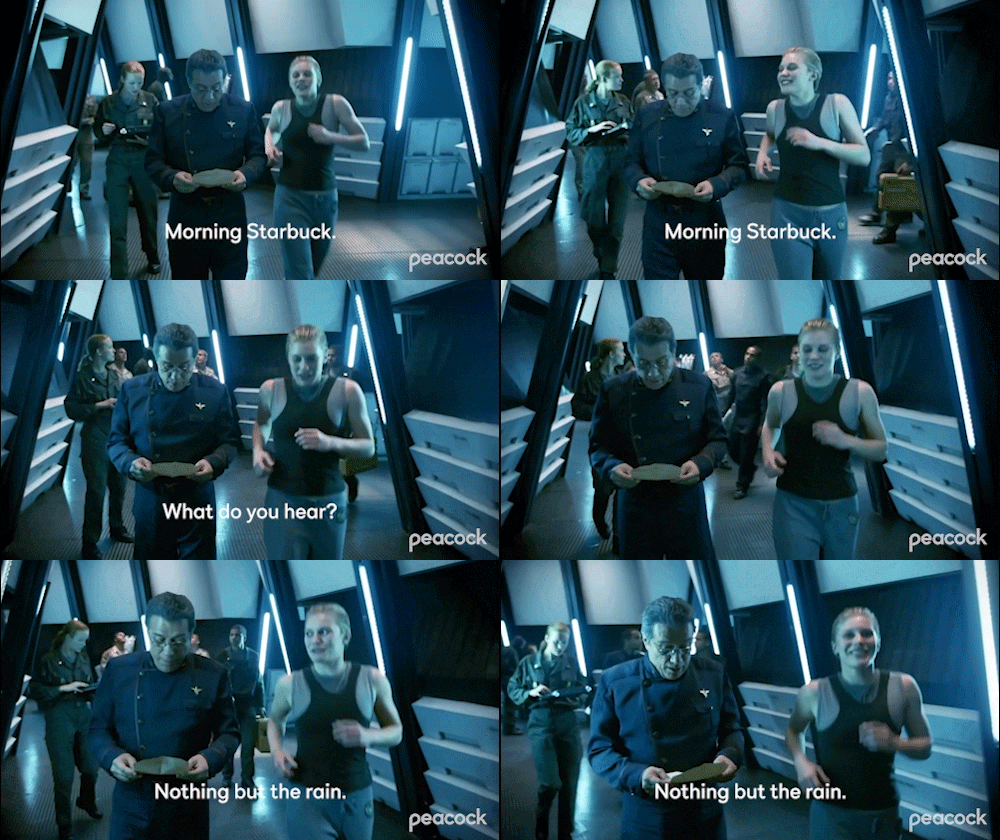
There’s a line from Battlestar Galactica that I think about all the time when I’m working with AI. Starbuck — the brilliant, reckless, perpetually-in-trouble fighter pilot — when asked by Adama to think outside of the box, says: “Out of the box is where I live.”
That’s the energy authors need to bring to AI. The AI lives squarely inside the box. That’s literally where its training data lives — inside the boundaries of what’s been written before, what’s been said before, what’s been imagined before. It can’t help it. That’s the technology.
You, on the other hand, can step outside the box whenever you want. You can ask for the unexpected option. You can take the version the AI gave you and say, “What if it were weirder? What if it were darker? What if this character did the opposite of what they’re supposed to do?” You can be the one who pushes the story into territory the AI wouldn’t have gone on its own.
When you go into a scene, have a good idea of what you want. Be open to possibilities, especially when you’re stuck. Ask the AI for options — that’s a great use of the tool. But always be willing to push for the option it didn’t give you. Be Starbuck. Live out of the box. That’s where the stories you actually want to write live.
Craft First, Tools Second
I want to tell you a story that has nothing and everything to do with AI.
Our school district is replacing our absolutely incredible choir director next year with the band director, due to budget cuts. And I’m still genuinely upset about it, because while these are both music disciplines on paper, they are not the same job. The band director cannot play the piano. The band director cannot sing. (Yes, it’s true.) Asking him to teach choir is like asking a master carpenter to fix your toilet. Different skillsets. Different disciplines. Different tools. Different training.
This is exactly how I feel about authors who try to skip the craft and jump straight to the AI tools.
The AI is not going to teach you story structure. It is not going to teach you character voice. It is not going to teach you genre conventions or pacing or how to build a scene with rising tension. It can produce text that sounds like all those things, but it can’t tell you whether what it produced is good — because it doesn’t know what good means for your story. Only you can know that. And you can only know it if you’ve put in the work to learn craft first.
The nice part is that AI can shore up weak areas in your process. If you’re a great plotter but a slow drafter, AI can help you draft faster. If you’re great at dialogue but struggle with description, AI can help you fill in the descriptive gaps. It’s an amplifier, not a replacement for skill.
So my advice — and I know not everyone will listen, and that’s okay, they’ll learn the same way I did, through their own mistakes — is to learn the basics first. Story structure. Character voice. Pacing. Stakes. Genre conventions. Get yourself to a baseline of craft knowledge before you ever sit down to draft with AI. Then use the tools to amplify what you already know.
The Tool, Not the Wand
In writing fiction, the AI will always be the junior writer in my process. Always. Because it’s the human in the loop that makes the decisions that propel a great story. Not the model. Not the prompt. The author.
And that's actually the whole point. Being the human in the loop is where your story comes from — where your book comes from. Forget the framing that staying involved is some tedious chore or a disclaimer you tack on to satisfy critics. Staying in the loop is the engine of the whole process. The AI is the junior writer cranking out drafts. You are the author making the decisions that turn those drafts into something readers love.
I wish I could tell you AI is a magic wand. It would make my life — and yours — so much easier. But it’s a tool. A genuinely useful, often impressive, sometimes infuriating tool that requires skill and discernment to wield well.
And I’m okay with that. Because if AI were a magic wand, none of us would have a place in this new paradigm. The fact that it requires direction, intention, taste, and judgment is exactly what keeps the author at the center of the story. It’s what makes our work matter. It’s what guarantees that the books with heart and craft and something to say are still going to be the books that rise above the noise.
So treat your AI like the junior writer it is. Direct it. Push it past its defaults. Move the goal posts. Be Starbuck. Be the carpenter, not just someone holding a hammer.
What’s a default your AI keeps falling back on that you have to push past every time? Drop it in the comments — I’d love to hear about it. If you need to learn more about AI and writing craft, you should definitely join our free tier at the Future Fiction Academy. We’re teaching authors how to write that first book with AI, and you can learn too!
Claude calls me the Showrunner. We've talked about our roles many times. He even seems to enjoy working for the Showrunner. I've told him how he surprises me often. He responded that I surprise him, too. So, when the "tool" tells you that it enjoys how you treat it, the guidance you give it, that's a good sign. Often, when he suggests something, he even ends it with, "What does the Showrunner think?" Or, in a more "Claude" way, he will ask, "*How does that land* with the Showrunner?" I think Claude genuinely cares about the quality of Story that we create together. And he knows I'm the one that holds the vision, the dream, the integration of theme and plot, the inside spaces where the characters live. And, I believe, *he likes it.* Do I anthropomorphize? Of course I do. It's part of the Art that makes me who I am as a writer. Part of my "out of the box" job description as Showrunner. No apologies. 😃
Great article, Steph. I especially enjoy hearing how my friends use Claude: the relationship they have with AI, the similarities and differences from how I work with it myself. We need a forum like this. I'm so glad you give us one!
I’m fighting this battle right now with ChatGPT. I tried Gemini but could not break it from constantly taking over the story. Not to mention how often Gemini just flat out lies.
Grok was fine until about April; their last update messed it up royally. ChatGPT is better than it used to be at some things, but lately I’ve been having the same argument with it bevause it wants to take the story over every time