


A statistic from the Stanford 2026 AI Index Report stopped me in my tracks recently, and I haven’t stopped thinking about it since: generative AI hit 53% global adoption in just three years. That’s faster than the PC. Faster than the internet. Some countries are even further along — Singapore is at 61%, the UAE at 54%. The estimated value of generative AI to U.S. consumers alone reached $172 billion annually by early 2026, with the median value per user tripling between 2025 and 2026. (See Chapter 4: Economy.)
In other words: half the planet is having ongoing conversations with AI tools, and the value they’re getting out of those conversations is growing fast.
Now think about what those people are asking. They’re asking for life advice. Career advice. Travel tips. Recipes. Health questions. And — yes — book recommendations. TV recommendations. Movie recommendations. “What should I read next that’s like X?” You just gotta know that has to be one of the single most common queries in any AI chat window in the world.
Here’s the question every author needs to be asking themselves right now: when someone asks ChatGPT, Claude, Gemini, or Perplexity to recommend a book like mine — do my books show up?
If your books aren’t anywhere on the open, public web — if your only presence is an Amazon listing and a Facebook page — the honest answer is probably no. And that gap is going to widen every single month from here.
The Paradigm Has Shifted (Not Died)
I’m not here to tell you social media is dead. It’s not. Touring isn’t dead. Conventions aren’t dead. Newsletters absolutely aren’t dead (they might actually be more important than ever). All of those old marketing channels still have merit, and authors are still finding readers through them every single day.
But the old paradigm — where “be where the readers are” meant Facebook, Instagram, TikTok, in-person events — has expanded. Now it also means being inside the AI conversations your readers are having when they’re nowhere near social media. There are millions of people who will never touch a Facebook page in their lives but who will absolutely ask Gemini, “What’s a great cozy mystery set in Japan?” When you’re not visible to the AI, you’re invisible to those readers.
This is a “social media and” moment, not a “social media or” moment. You don’t have to leave any platform behind. But you do have to do more — and do it on the open web, where AI can actually see you.
My Four-Month Experiment
A while back, I made a deliberate choice that some authors thought was a little nuts.
I put every single book I’ve ever written on my website. In HTML. Free. For four months. No paywalls, no gating, no email-capture before reading. Just my entire catalog, sitting there on the open web, ready to be read by anyone — or anything — that happened by.
The reason was strategic. I wanted to make sure all the major AI web crawlers — GPTBot from OpenAI, ClaudeBot from Anthropic, Google’s Gemini crawler, Perplexity’s bot — had a real chance to find, index, and learn from my full body of work. When an AI tool gets asked, “Recommend me a Japanese-inspired sci-fi romance with strong female leads,” I want it to actually have a clue who I am. The only way for that to happen is for my actual writing to live somewhere it can read.
After those four months, I changed the setup. The first four chapters of every book stay open in the clear. The rest of each book sits behind a free membership wall, which readers love because they can keep reading without paying a cent. The AI got fed. The readers are happy. My catalog is now alive on the open web in a way that didn’t exist before.
I don’t know any other author who has done this on purpose. I’m convinced more of us should.
And Then There’s the Blog
The other half of my discoverability is something I’ve been building for fourteen years, almost entirely by accident.
I started my author blog in 2011. I’ve posted over 1,000 times. I’ve written about my books, my characters, my themes, the places I set my stories in, my research trips, my craft, my struggles, my favorite recipes, my obsessions, my life. All of that — every single post — has been scraped by the major AI crawlers and folded into their training data and retrieval systems.
The result is that AI models know me. They know what I write. They know my voice. They know what my books are about. They know enough to recommend me when the right query comes through. I didn’t plan it that way back in 2011 (no one did, the technology didn’t exist), but it turns out fourteen years of consistent blogging is one of the best marketing investments I’ve ever made.
There used to be a fairly well-known sci-fi author who loved to tell anyone who would listen that “websites and blogs are dead.” She was wrong. (She was wrong about a lot of things, actually.) The people who quietly kept blogging anyway are the ones the AI knows about today.
Everything old is new again. Blogs are back, baby.
What Actually Shows Up in AI Search Results
I did an experiment recently. I opened an incognito window, fired up Gemini, and asked it for book recommendations in my genre. Here’s a snapshot of what came up:
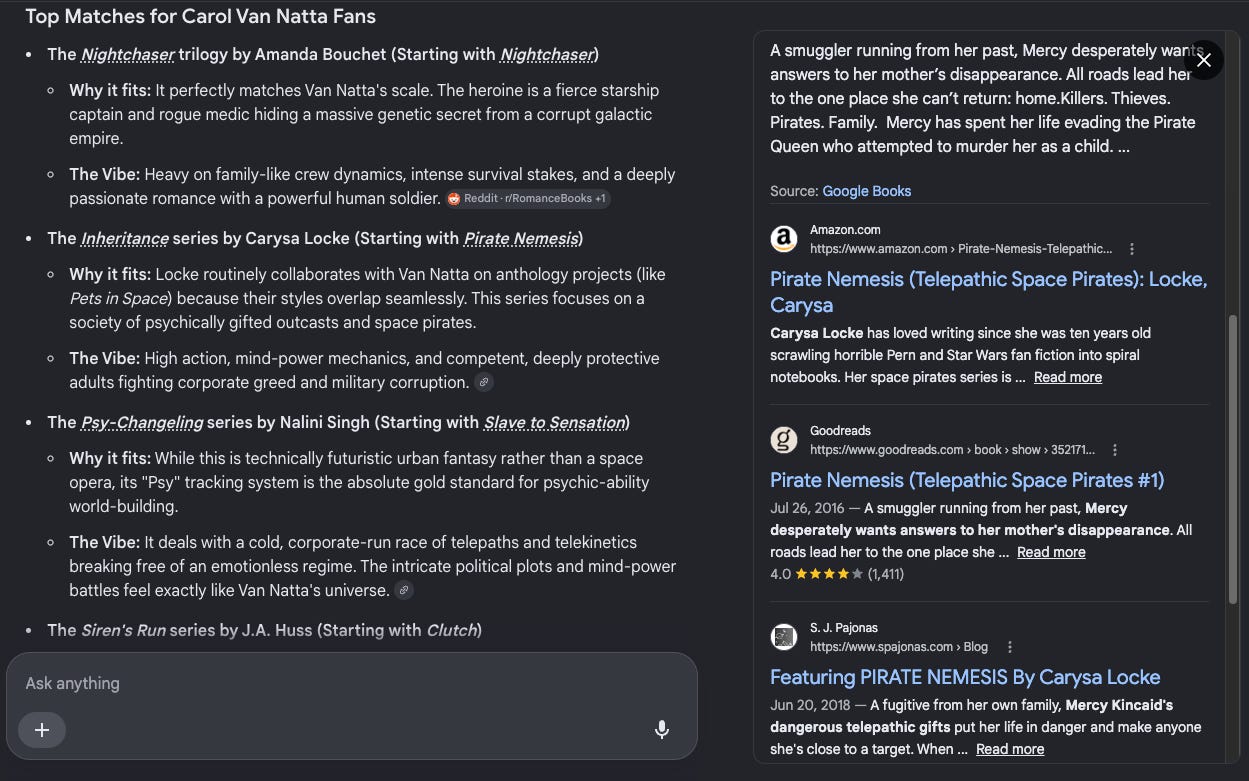
In the response on the left, Amazon doesn’t even show up. Goodreads (which Amazon owns) shows up once or twice — but it gets beaten out by Reddit. The rest? Book blogs. Yep, book blogs (remember those?). Instagram. Medium. Author websites.
Now look at the column on the right. This is what you get when you click on the Pirate Nemesis link on the left (Hey, Carysa!) At the top, a Google Books description. Finally, an Amazon link. And then one of the top sources is my own blog promoting Carysa Locke’s book. Hilarious, and also exactly the point. (Also, a great book. Go read it.)
This is what AI book recommendations actually source from. Not Amazon. Not your KU page. The open, public, indexable web — and the people writing about books on it.
A few things to notice:
Google Books descriptions matter. Most KU-only authors never optimize these because they don’t publish through Google Play. If you’re wide, fix yours. Now.
Reddit beats Goodreads in this particular search. Yes, Reddit. The author who shows up in Reddit threads about their genre has a discoverability advantage you can’t buy.
Author websites consistently land in the top hits, often right after the storefronts for specific books.
Book blogs are gold. More than half of the sources in my search were other people’s blogs talking about books. This is why blog tours, blog swaps, blog rings, and cross-promotion with other authors on the open web are back and stronger than they’ve been in a decade. You heard it here first! (Someone is bound to come along and tell me I’m wrong. Lol. I expect it.)
When friends recommend each other on their websites and blogs, that recommendation is now feeding the AI. I had no idea about this until I started checking, but I’ve been told by readers that Claude has recommended my books to them. Gemini surfaces my friends Carol Van Natta and Carysa Locke when you dig a query down a layer or two. The system is already in motion, whether we notice it or not.
The KU Question (Honestly)
I want to address this one carefully, because I know a lot of you are reading this from inside the Kindle Unlimited bubble, and I don’t want to be the person yelling “go wide!” at you. I’ve been KU-exclusive in the past myself. There’s no shade here.
The honest truth is that KU exclusivity puts you at a real disadvantage when it comes to AI discoverability, because your actual book content lives behind Amazon’s walls — and Amazon is not feeding that content to OpenAI or Anthropic or Google. The AI can’t index what it can’t reach.
That doesn’t mean you can’t be discoverable. It means you have to work harder on everything else. Your blog stops being optional. Your website needs to do more heavy lifting. Your presence on third-party sites, book blogs, and reader communities becomes essential rather than nice-to-have. Every choice you make about your author footprint matters more.
If KU is the right financial decision for you right now, run with it. Just make sure you’re aggressive everywhere else.
Five Concrete Moves to Make Your Website AI-Discoverable
Okay, tactical section. Here are the moves I’d make this week if I were starting from scratch — or auditing what I already have. (Speaking as someone who’s been building websites professionally for a long time and still builds plenty of them on the side.)
1. Publish wide if it’s financially feasible. Even a few of your books wide can make a meaningful difference. Apple, Kobo, Barnes & Noble, Google Play — every additional store is another set of metadata, descriptions, and previews that AI crawlers can reach.
2. Run a real blog and don’t stop. Especially if you’re KU-exclusive. Write about your books, your themes, your characters, your inspiration, your settings, your craft, your reading life. Be generous and consistent. And do not underestimate the power of trading blog posts with author friends in your genre. Blog tours and blog rings are coming back. Be ready when they do.
3. Put actual book content on your website. Sample chapters at minimum. Whole books if you have the rights and the courage. If you’re exclusive to Amazon, you can still have a rich book page — blurb, tropes, hooks, character bios, sample dialogue, behind-the-scenes posts. The point is that your book exists as readable, indexable content somewhere on the open web.
4. Build dedicated pages for your books, series, and characters. Real URLs with real content. Character pages with bios, images, even AI-generated theme songs from Suno if you’re feeling fun. (Don’t judge me, I’m building these for my own characters now and they’re a blast.) FAQ pages help too — things like “Where should I start with the Flyght Series?” or “What is the Amagi Series about?” mirror exactly the kinds of questions readers ask AI tools.
5. Use crawlable web tech, and check your robots.txt. Clean, semantic HTML. Avoid single-page-app builds that hide content from crawlers. Double-check your robots.txt to make sure you haven’t accidentally blocked GPTBot, ClaudeBot, Google-Extended, or PerplexityBot — those are the bots that actually feed AI tools, and a misconfigured file can lock them all out without you ever realizing it.
While you’re at it, consider adding structured data (schema.org markup) to your book and author pages. It’s a small chunk of JSON that explicitly tells AI crawlers “this is a book,” “this is the author,” “this is the ISBN,” “this is the genre.” Most SEO plugins (Yoast, Rank Math) handle the basics automatically. If you want to go deeper, ask Claude — it’ll walk you through exactly what to add for your specific stack. (I’m sorely tempted to build a custom plugin for this myself. I’ll save that nerdery for another post.)
Bonus tactic: if you’re considering a website rebuild, Shopify is a legitimate option for authors who want to sell direct. It blogs, it’s SEO-friendly out of the box, and OpenAI has partnered with Shopify to surface Shopify product results inside ChatGPT responses. If selling direct is part of your model, that’s a real edge.
And don’t forget the third-party sites that show up constantly in AI source lists: Goodreads, BookBub, your own newsletter archive (publicly archived on the open web), reader-focused subreddits, book blogger interviews. Get listed. Stay listed. Be findable in more than one place.
Be More Human, Not Less
Here’s the punchline. AI-driven discovery is amplifying the human side of marketing, not replacing it. The most human parts of your marketing presence — your blog posts, your voice, your behind-the-scenes stories about how you write, your relationships with other authors, your generosity with content on the open web — are exactly the parts AI sees and learns from.
Authors who are more human, more available, more willing to share are the authors AI will recommend. Authors who are locked away behind a single storefront with no public footprint will keep getting quieter and quieter as the percentage of book discovery happening through AI keeps climbing.
The competition has changed. We’re no longer fighting for shelf space — we’re fighting to be findable in an ocean of content. The way you stand out is by being a real, generous, present human on the open web. Not by being louder. By being more knowable.
What to Do This Week
If this article landed for you, here’s the action list:
Open your author website. Does it have your books on it? Sample chapters? Blog posts about them?
Pull up your robots.txt. Are AI crawlers blocked? Unblock them.
Pick one thing you’ve been meaning to write about for a year and finally publish that blog post.
Open an incognito window, ask Claude or Gemini for a book recommendation in your genre, and see what shows up. Then ask yourself: how do I get there?
You don’t have to do all of this at once. You just have to start.
Have you ever caught your own book — or a peer’s — being recommended by an AI? Drop the story in the comments, I want to hear it. And if you’re newer to AI for your author business and want a grounded, practical place to start, our free tier at the Future Fiction Academy has resources I’d recommend to anyone.
I had started posting to my blog again, but I’ve quit. I felt like it was a waste of time, but now I see it’s not. What are you using for your website? Wordpress?
Thanks Steph. You’ve inspired me to ‘press on’ with Wordpress even though there’s a big learning curve. I’ve looked at the other two (Square space and Wix) but keep hearing that WPress is the way. Any tips for the beginner? I gather Claude can help as well.